The Duo-Grid and Cubed-Sphere Grid Imprinting
Motivation
Grid discontinuities introduce numerical errors and artifacts in simulations on the cubed-sphere grid. These errors, often referred to as grid imprinting, manifest as spurious patterns aligned with the cube edges, degrading the accuracy of the solution and complicating the interpretation of results. The Duo-Grid addresses this issue by remapping data onto a more natural grid configuration, reducing the impact of the cube’s geometric discontinuities.
The problem: grid imprinting
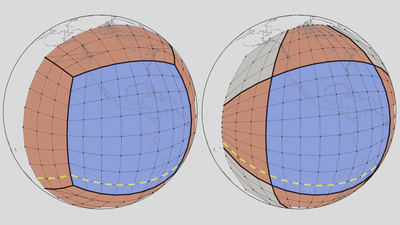
The gnomonic cubed-sphere grid has excellent accuracy and uniformity, but the coordinates have a kink at the cube edges. In the halo region this kink leaves a visible imprint of the cube in the solution and requires special edge handling throughout the solver.
The Duo-Grid
To reduce grid imprinting, we implemented the novel Duo-Grid within FV3. The Duo-Grid remaps a cube face’s data from the neighboring face, moving it from the kinked locations to natural locations along great circle lines using 1D piecewise linear interpolation. A separate 2D interpolation algorithm fills the correct data at the eight corners of the cubed-sphere, which FV3’s 2D advection scheme requires.
Validation
The Duo-Grid was evaluated across a comprehensive suite of idealized test cases spanning both two-dimensional shallow-water dynamics and three-dimensional hydrostatic and non-hydrostatic flows. These tests were designed to assess the impact of the Duo-Grid on grid imprinting, numerical errors, and the overall behavior of the FV3 dynamical core.
The steady-state geostrophic balance test provides a direct assessment of cubed-sphere grid imprinting. When the flow is oriented perpendicular to the cubed-sphere edges, the conventional kinked grid produces errors aligned with the cube geometry. With the Duo-Grid, these grid-aligned errors are substantially reduced.
The improvement extends to fully three-dimensional dynamics. In the baroclinic wave test, the Duo-Grid suppresses the development of cubed-sphere imprinting and errors in the southern hemisphere while maintaining the evolution of the solution over time.
The Duo-Grid was further evaluated using a broad suite of standard idealized tests, including shallow-water steady-state geostrophic flow, the splash test, Rossby–Haurwitz wave, colliding modons, cosine-bell advection, and the three-dimensional non-hydrostatic baroclinic wave.
Across these tests, the Duo-Grid consistently reduces grid imprinting and numerical errors while preserving the accuracy and numerical characteristics of the original FV3 formulation.
Key results
- Grid imprinting of the cubed sphere is greatly reduced in idealized tests and practically eliminated.
- Duo-Grid decreases the growth rate of error norms in all cases compared to the kinked grid, up to one order of magnitude.
- Order of accuracy of FV3’s horizontal discretization is conserved.
- Dispersion and dissipation properties are identical to those of the original FV3 algorithm.
- Edge handling code is eliminated -> significant performance gain in current/future GPU development
- FV3’s robustness and accuracy have increased.
These results indicate a clear improvement in FV3’s robustness and numerical accuracy.
Reference
Mouallem, J., Harris, L., and Chen, X.: Implementation of the Novel Duo-Grid in GFDL’s FV3 Dynamical Core, Journal of Advances in Modeling Earth Systems, 15(12), 2023. https://doi.org/10.1029/2023MS003712