Induction Heating of Dispersed Metallic Particles in a Turbulent Flow
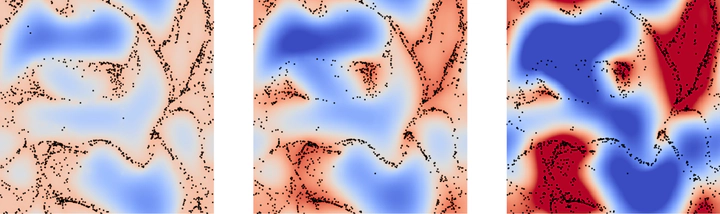 Particle clustering and gas temperature field during induction heating
Motivation
Induction heating of particles in flight is relevant to advanced combustion and energy conversion systems. This DNS study reveals how rapid heating reduces particle clustering and alters turbulent structures, informing the design of more efficient heating systems.
Overview
Inductively heated solid particles dispersed within a decaying isotropic turbulent carrier gas are investigated via Direct Numerical Simulation (DNS). The multiphase simulations account for the compressibility and temperature-dependent viscosity of the carrier gas.
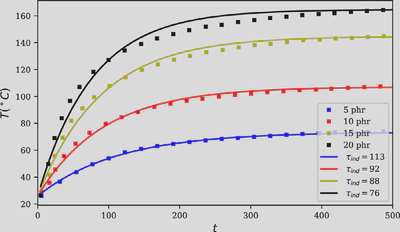
We develop a semi-empirical model for solid particle heating through hysteresis and Joule mechanisms, as these dispersed particles are heated by an external high-frequency alternating magnetic field.
Key results
- The growth of the Kolmogorov length scale is due to a simultaneous increase in viscosity and decrease in the dissipation rate.
- The temperature-dependent viscosity of the gas leads to a faster decay of the gas turbulent kinetic energy, mainly through a loss of energy at intermediate wavenumbers.
- The gas and particle thermal fluctuations are inversely correlated, set by the relative thermodynamic timescales.
- Two regimes appear in the temperature spectrum: while thermal fluctuations grow, thermal energy increases monotonically in the low-wavenumber range; once they decay, the decay occurs across the entire spectrum.
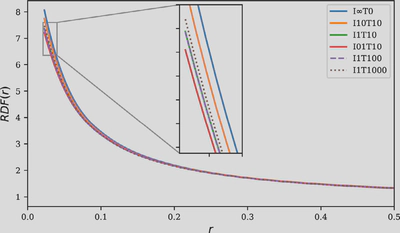
- Aggressive heating (shorter induction heating timescales) reduces particle clustering, whereas the particle thermal response time shows no such effect.
Heating de-clusters the particles
Preferential concentration is measured with the radial distribution function. The unheated case shows the strongest clustering at small separations, and the clustering weakens monotonically as the induction heating becomes more aggressive, while changing the particle thermal response time leaves the distribution essentially unchanged.
Reference
Mouallem, J. and Hickey, J.-P.: Induction heating of dispersed metallic particles in a turbulent flow, International Journal of Multiphase Flow, 132, 103414, 2020. https://doi.org/10.1016/j.ijmultiphaseflow.2020.103414