Macro-Scale Effects on Sub-Grid Closures in Gas-Solid Riser Flows
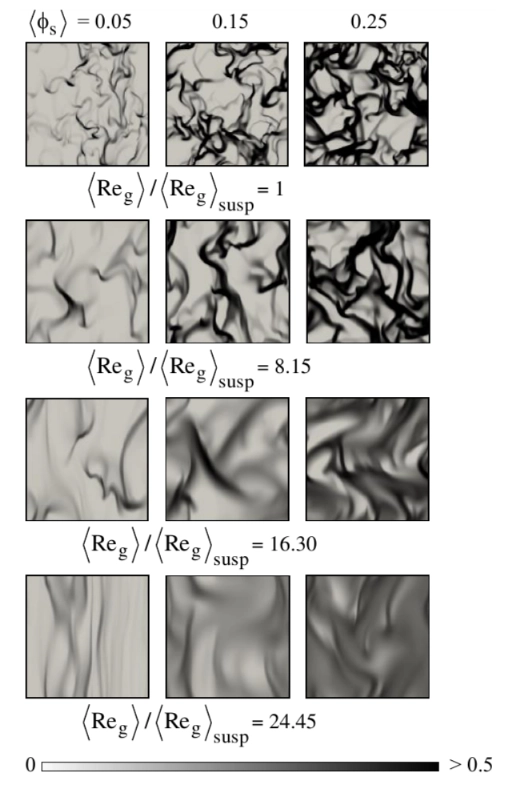 Solid volume fraction fields across solids loadings and gas Reynolds numbers
Motivation
Sub-grid closures for two-fluid models are traditionally derived at a single scale, but this work demonstrates that flow topology at the system scale strongly affects closure accuracy. Accounting for these effects is essential for predictive industrial riser flow simulations.
Background
Filtered two-fluid formulations of gas-solid fluidized flows require closure models to deal with sub-grid filtered parameters. These closures are derived by filtering the results of meso-scale highly resolved simulations (HRS) with two-fluid modeling, and then applying them on the coarse large-scale simulation (LSS) grid.
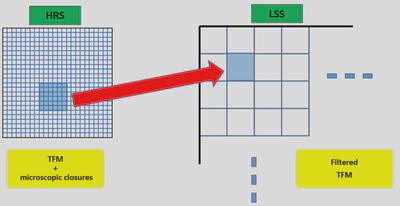
The question
Trusting in scale separation, the correlation of filtered parameters has traditionally been performed against meso-scale filtered data only, disregarding any macro-scale effects. In this work, the correctness of that practice is tested — and it fails.
Approach
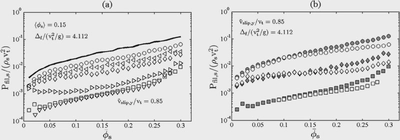
Two macro-scale parameters associated with flow topology are considered for their effects on the relevant filtered parameters: the average solid volume fraction and the average gas Reynolds number. Highly resolved simulations are filtered while holding each of these macro-scale parameters constant at various levels. The interest is directed toward the dilute conditions typical of riser flows.
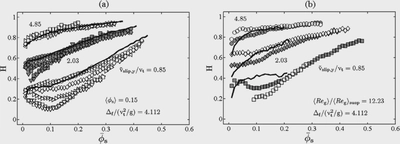
The drag closure is not scale separated
The drag coefficient correction H, the single most influential sub-grid term, is the clearest evidence of the failure of scale separation. Correlating H against the meso-scale filtered variables alone leaves a systematic spread that is set entirely by the macro-scale state of the flow.
The same holds for the stress closures
The effect is not limited to drag. The filtered solid pressure, which closes the solid-phase momentum equation, shifts by roughly an order of magnitude across the range of macro-scale conditions at an otherwise identical filtered state.
Conclusion
Results show that both macro-scale parameters should be accounted for in sub-grid correlations if higher accuracy is to be achieved.
Reference
Mouallem, J., Chavez-Cussy, N., Niaki, S. R. A., Milioli, C. C., and Milioli, F. E.: On the effects of the flow macro-scale over meso-scale filtered parameters in gas-solid riser flows, Chemical Engineering Science, 182, 200-211, 2018. https://doi.org/10.1016/j.ces.2018.02.039