SHiELD-MOM6: High-Resolution Coupled Atmosphere-Ocean Modeling
Motivation
Air-sea interactions drive storm intensity and ocean response. This coupled system captures two-way feedback between the atmosphere and ocean at kilometer scales, enabling accurate simulations of hurricane-ocean interactions and coastal impacts.
Overview
We present a new high-resolution coupled atmosphere-ocean model, SHiELD-MOM6, which integrates GFDL’s advanced atmospheric model, the System for High-resolution modeling for Earth-to-Local Domain (SHiELD), the Modular Ocean Model version 6 (MOM6), and the Sea Ice Simulator (SIS2).
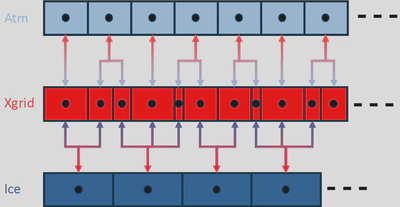
The model leverages the Flexible Modeling System (FMS) coupler and its innovative exchange grid to enable a robust and scalable two-way interaction between the atmosphere and ocean. The atmospheric component is built on the non-hydrostatic Finite-Volume Cubed-Sphere Dynamical Core (FV3) with the latest version of the SHiELD physics parametrization suite, while the ocean component is the latest version of MOM, supporting kilometer-scale high-resolution and regional applications.
Coupling infrastructure
The SHiELD-MOM6 model employs the Flexible Modeling System (FMS) coupler, which facilitates the exchange of information between the atmospheric and oceanic components. The exchange grid ensures accurate and efficient communication, enabling the two-way interaction necessary for realistic coupled simulations.
Hurricane Helene (2024)
Validation is demonstrated through a suite of experiments, including idealized hurricane simulations and a realistic North Atlantic case study featuring Hurricane Helene 2024. The animation below shows the simulated sea level pressure and 10 m winds (left) alongside the sea surface temperature anomaly and ocean surface currents (right) as the storm crosses the Gulf.
Scalability
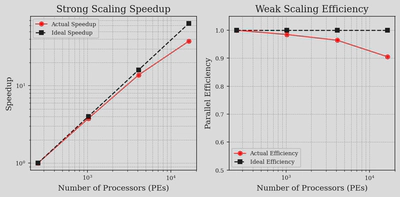
Scalability tests have been conducted to evaluate the model’s performance on massively parallel computing systems. The results demonstrate that SHiELD-MOM6 maintains high computational efficiency as the number of processors increases, ensuring that high-resolution coupled simulations can be performed within practical timeframes
Key results
- Air-sea interactions are effectively captured, both in storm intensity and structure and in the ocean response.
- The coupling reproduces ocean phenomena such as storm-induced upwelling, the cold wake, and sea level changes.
- Scalability tests confirm the model’s computational efficiency on massively parallel systems.
This work establishes a unified, modular cornerstone for advancing high-resolution coupled modeling, with significant implications for weather forecasting and climate research.
Reference
Mouallem, J., Gao, K., Reichl, B. G., Chilutti, L., Harris, L., Benson, R., Zadeh, N., Chen, J., Chen, J.-H., and Zhang, C.: Development of a high-resolution coupled SHiELD-MOM6 model – Part 1: Model overview, coupling technique, and validation in a regional setup, Geoscientific Model Development, 18(18), 6461-6478, 2025. https://doi.org/10.5194/gmd-18-6461-2025