A Minimal, Adiabatic Example of Sudden Stratospheric Warming
Motivation
Sudden stratospheric warmings have profound impacts on surface weather weeks later. This idealized modeling study isolates the key physical mechanisms driving SSW dynamics, building intuition and validating model representations of stratospheric-tropospheric coupling.
Overview
Sudden Stratospheric Warmings (SSW) are extreme events that can significantly impact weather patterns on short, subseasonal and seasonal timescales. In this study we present a new idealized test case of an SSW event implemented in GFDL’s FV3 dynamical core.
Setup
The initial condition features a wintertime stratospheric circulation with a westerly jet in the Northern Hemisphere and an easterly jet in the Southern Hemisphere. In the absence of tropospheric wave forcing, the model preserves this stratospheric circulation for approximately 200 days, which makes it a clean baseline.
To induce an SSW, we introduce a moving mountain that generates planetary waves of a prescribed zonal wavenumber.
The moving mountain is introduced through a time-dependent surface geopotential perturbation,
$$ \phi’ = g h_0 \sin\left(\frac{r,\mathrm{time}}{20}\right) \sin^2\left[ \frac{\pi(\phi-\phi_1)}{\phi_2-\phi_1} \right] \cos\left( z_w\lambda+\frac{10sr,\mathrm{time}}{360} \right), \qquad \phi_2\geq\phi\geq\phi_1. $$
where (g) is gravitational acceleration, ($h_0$) is the mountain height, ($\phi_1$) and ($\phi_2$) define its latitudinal extent, ($z_w$) is the zonal wavenumber, ($s$) controls the phase speed, and ($r$) controls the temporal forcing frequency. The westward-moving mountain generates planetary waves that propagate upward into the stratosphere and interact with the polar vortex.
Results
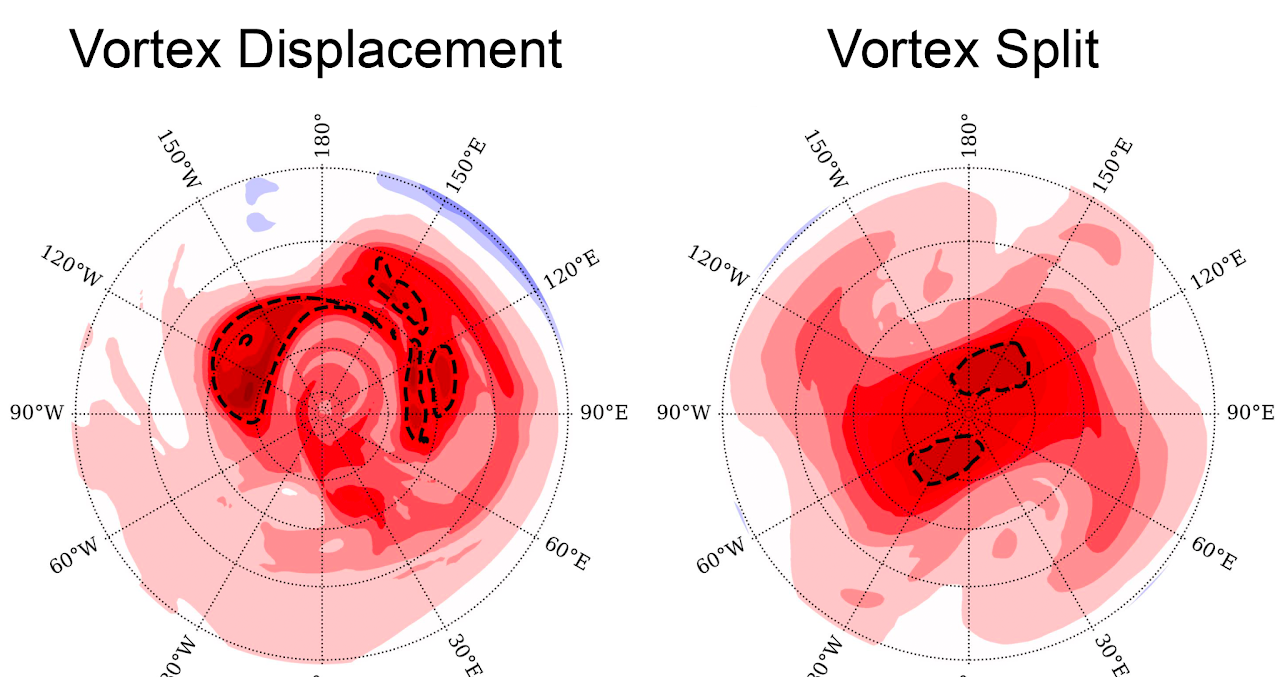
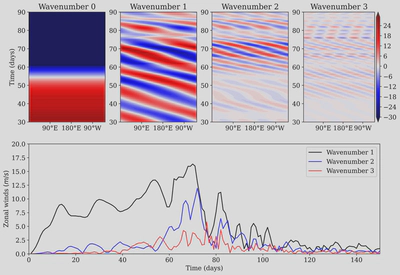
The Hovmöller diagram shows the temporal evolution of the zonal-wavenumber components of the 10 hPa zonal wind. The growth and propagation of the planetary-wave components illustrate how the imposed forcing develops and interacts with the stratospheric circulation leading up to the SSW.
The animation shows the evolution of the zonal-mean Eliassen–Palm (EP) flux and its divergence. The upward propagation of EP flux demonstrates the transport of planetary-wave activity into the stratosphere, followed by enhanced wave–mean-flow interaction and deceleration of the polar-night jet.
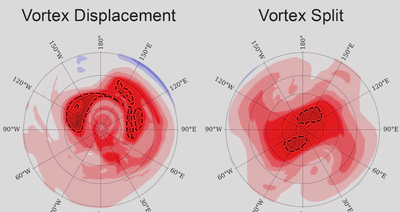
- Wavenumber-1 forcing leads to a vortex displacement SSW.
- Wavenumber-2 forcing produces a vortex split SSW.
Both are consistent with observations and the published literature.
This minimal setup offers a controlled environment for studying SSW dynamics and serves as a useful testbed for evaluating the ability of dynamical cores to capture key stratospheric processes and troposphere-stratosphere interactions.
Reference
Mouallem, J., Yao, W., Harris, L., Lin, S.-J., and Chen, X.: A Minimal, Adiabatic Example of Sudden Stratospheric Warming, Journal of Advances in Modeling Earth Systems, 17(9), 2025. https://doi.org/10.1029/2024MS004760