Targeted Particle Delivery via Vortex Ring Reconnection
Motivation
Precise particle targeting is important in manufacturing, propulsion, and medical applications. This work shows how vortex ring dynamics can coherently transport particles to specific wall locations, with design parameters (ring size, Stokes number) controlling delivery accuracy.
Concept
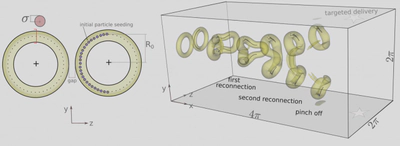
A conceptual model for targeted particle delivery is proposed using controlled vortex ring reconnection. Particles entrained in the core of a vortex ring are efficiently transported as the ring advects by self-induction.
Mechanism
A pair of these particle-transporting vortex rings traveling in the streamwise direction along parallel trajectories will mutually interact, resulting in a pair of vortex reconnection events. The reconnection causes a topological change to the ring, accompanied by a rapid repulsion in the plane perpendicular to the direction of travel. This effectively transports the particles toward the desired location on the sidewalls of a ducted flow.
In addition to proposing this conceptual model, we identify the dominant physics of the process and the design considerations required to achieve targeted delivery.
Particle inertia sets the delivery
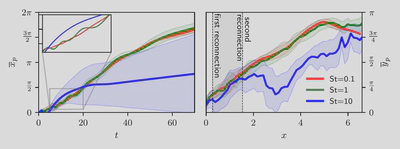
Whether the particles actually follow the rings is governed by the Stokes number. Low-inertia particles stay locked to the ring cores and are carried coherently through both reconnections, while high-inertia particles decouple from the vortex and disperse before reaching the wall.
Design considerations
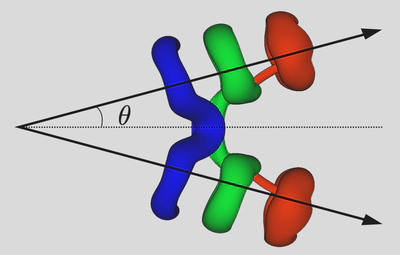
The ring radius, relative to the channel width, controls how strongly the rings repel after reconnection and therefore where on the sidewall the particles arrive. This makes ring size the primary design parameter for aiming the delivery.
Reference
Mouallem, J., Daryan, H., Wawryk, J., Pan, Z., and Hickey, J.-P.: Targeted particle delivery via vortex ring reconnection, Physics of Fluids, 33(10), 2021. https://doi.org/10.1063/5.0066443